I still remember sitting in my room, staring blankly at the ceiling after my 10th-grade board exams. "What next?" everyone asked. Some relatives swore by Science, my friends were all picking Commerce, and my heart secretly leaned towards Arts. If you are feeling that exact same knot in your stomach right now, take a deep breath. You are not alone, and this is completely normal.
The decision you make after Class 10 is one of the first major forks in your educational journey. With the introduction of the National Education Policy (NEP 2020), the old walls between subjects are breaking down, giving you more freedom than ever before. But more choices can also mean more confusion. The anxiety of making the "wrong" choice can be overwhelming. However, the truth is that very few choices in life are irreversible.
Let's break down the primary career paths after 10th grade in simple, easy-to-understand English so you can make the best choice for *your* future. We will explore the traditional streams—Science, Commerce, and Arts—along with the increasingly popular vocational and technical routes.
explore Interactive Maps
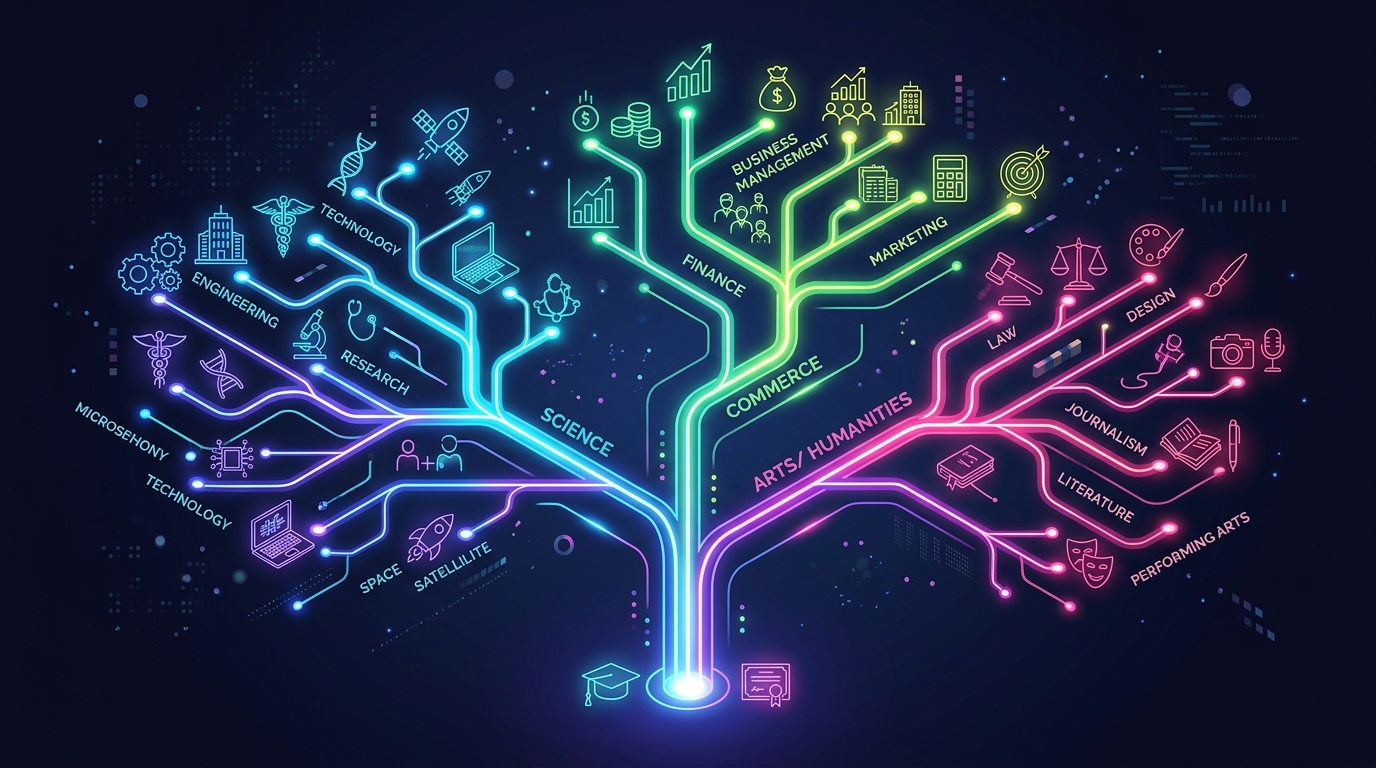
As you read my guide below, you can click on any highlighted pathway. It will automatically open the PathTree Education Canvas, zoom into that specific route, and visually map out where it leads—like a GPS for your career!
1. The Science Stream: Builders, Innovators & Healers
When I was in school, Science was often treated like the "default" choice for toppers. But the truth is, Science is for the naturally curious. If you constantly ask "How does this work?" or "Why does this happen?", this stream is your playground. It is rigorous, demanding, and incredibly rewarding. It generally splits into two main combinations, though modern schools increasingly allow blending them.
The Math Path (PCM)
The PCM Stream (Physics, Chemistry, Math) is the classic route for future engineers, architects, data scientists, and physicists. I have a friend, Rahul, who loved taking apart remote control cars as a kid. He took PCM, cleared the JEE, and now designs electric vehicle batteries.
This path is heavy on logic, calculations, and problem-solving. It opens doors to prestigious institutions like the IITs and NITs. But beyond traditional engineering, PCM is the gateway to cutting-edge fields like Artificial Intelligence, Machine Learning, Aviation, and ethical hacking. If you love numbers and analytical thinking, this is where you belong.
The Biology Path (PCB)
The PCB Stream (Physics, Chemistry, Biology) is for the healers and the life science enthusiasts. If you dream of wearing the white coat, becoming a doctor (MBBS), a dentist (BDS), or even exploring genetics and biotechnology, this is your route.
My cousin took this path because she was fascinated by how the human brain works—today she's studying to be a neurologist. Beyond medicine, PCB students can explore pharmacy, agriculture, forensic science, and bioinformatics. It requires a lot of memorization, patience, and a deep interest in the living world. The NEET examination is the primary hurdle here, but the alternative career paths are vast and growing rapidly.
2. The Commerce Stream: The Wealth Creators & Strategists
Do you love watching Shark Tank India? Do you find yourself wondering how huge companies make money, or how the stock market works? If yes, the Commerce Stream is calling your name.
Commerce deals with business, trade, and financial systems. Core subjects include Accountancy, Business Studies, and Economics, with optional subjects like Math or Informatics Practices. This path opens doors to becoming a Chartered Accountant (CA), an Investment Banker, a Financial Analyst, or starting your own company.
A girl in my neighborhood chose Commerce simply because she loved organizing events and managing budgets. She went on to do her BBA, followed by an MBA, and now runs her own successful event management company. It is the perfect path for organized, ambitious minds who want to understand the machinery that drives the global economy. Whether it's corporate law, banking, or entrepreneurship, Commerce is the language of business.
3. Humanities & Arts: The Thinkers, Creators & Changemakers
For a long time, people misunderstood the Arts/Humanities Stream, treating it as a fallback option. Let me be absolutely clear: some of the most powerful and influential people in India—top IAS officers, renowned lawyers, award-winning journalists, and brilliant psychologists—came from the Humanities stream.
Humanities is all about studying human society, culture, behavior, and history. You will dive into subjects like History, Political Science, Psychology, Sociology, Geography, and Literature. My favorite teacher once told me, "Science tells us how to build a nuclear bomb, but Humanities tells us why we shouldn't drop it."
If you are creative, love reading, have strong opinions, and want to bring change to society, do not hesitate to choose Humanities. It is the perfect foundation for careers in the Civil Services (UPSC), Law, Journalism, International Relations, Design, and Social Work. In a world increasingly dominated by AI, the uniquely human skills of critical thinking, empathy, and communication taught in Humanities are becoming more valuable than ever.
4. Early Action: Vocational & Technical Paths
What if you don't want to sit in a classroom for two more years reading textbooks? What if you want to start working with your hands, building things, and earning money sooner? India has excellent alternatives for you that bypass the traditional 11th and 12th grades entirely.
Polytechnic Diplomas
A Polytechnic Diploma is a 3-year specialized course in engineering disciplines (like Mechanical, Civil, or Computer Science). The best part? After finishing it, you can get a "lateral entry" directly into the 2nd year of a B.Tech degree! It's an amazing backdoor entry for practical learners who prefer hands-on experience over theoretical physics. It also makes you highly employable at an early age.
ITI (Industrial Training Institutes)
If you want to master a highly specific trade—like becoming an expert electrician, a welder, a fitter, or an AC mechanic—an ITI Certification takes just 1 to 2 years and gets you job-ready immediately. The railways, electricity boards, and massive manufacturing sectors are always hunting for good ITI graduates. It's a fantastic way to secure stable employment quickly.
Paramedical & Short-term Courses
There are also numerous diploma courses in paramedical sciences (like Medical Lab Technology), animation, graphic design, and digital marketing that you can pursue immediately after 10th. These are skill-based courses designed to get you into the workforce with specialized abilities.
5. How to Make the Final Decision
So, how do you actually choose? Here is a simple, three-step framework:
- Analyze Your Interests: What subjects do you actually enjoy studying? Not the ones you score the highest in because of rote learning, but the ones you naturally gravitate towards. What do you read about in your free time?
- Identify Your Strengths: Are you good with numbers? Are you a great communicator? Do you have a knack for visual design? Match your natural aptitudes to the streams.
- Look at the End Goal: Work backward. If you know you want to be an architect, you need PCM. If you want to be a CA, Commerce is the most logical route. Use the PathTree canvases to trace the careers back to the streams.
My Final Advice to You
The biggest mistake I made at 15 was thinking my choice was permanent. It's not. I have seen Commerce students become brilliant fiction authors, and Science students pivot to become top corporate lawyers or designers. The NEP 2020 is also making it easier to mix subjects, allowing you to study Physics with Music, or Accountancy with Psychology.
Don't pick a stream just because your friends are doing it, or because society thinks it's "prestigious". Prestige doesn't pay the bills of happiness. Pick the one that excites you today. Play to your strengths. Dive deep into what you love, and the success will follow.
Ready to explore your options visually? Head over to the Education Canvas and map out your own future!
6. Stream-by-Stream Entrance Exam Guide: What You Will Actually Sit For
The stream you choose in Class 11 is not just an academic decision—it is a gateway to specific entrance examinations that will determine your college and career. Understanding the major national examinations linked to each stream allows students and parents to make genuinely informed decisions rather than guessing based on peer pressure or social media myths.
| Stream | Primary Entrance Exam | Conducting Body | Top Institutions Unlocked |
|---|---|---|---|
| Science (PCM) | JEE Main + JEE Advanced | NTA / IIT Joint Board | IITs, NITs, IIITs, BITS Pilani |
| Science (PCB) | NEET-UG | NTA | AIIMS, JIPMER, State Medical Colleges |
| Commerce | IPMAT (IIM Integrated), CUET-UG | IIM / NTA | IIM Indore/Rohtak 5-Yr IPM, Central Universities |
| Arts / Humanities | CLAT, CUET-UG, NID DAT | NLU Consortium / NTA / NID | NLUs (Law), Central Universities, NID/NIFT (Design) |
| Vocational / ITI | State ITI Entrance / Polytechnic CET | State DTE / Boards | Government ITI Institutes, State Polytechnics |
7. NEP 2020 and the Changing Face of Indian Education After 10th
The National Education Policy (NEP) 2020, implemented progressively since 2021, represents the most comprehensive transformation of the Indian education system since the Kothari Commission of 1966. For students choosing streams after Class 10, NEP 2020 introduces structural flexibility that fundamentally changes what "choosing a stream" means.
Under NEP 2020's multidisciplinary framework, the rigid compartmentalization of Science, Commerce, and Arts is being dismantled. Students at NEP-implementing schools and universities can now combine subjects across traditional stream boundaries. A student can study Physics, Economics, and Political Science together. A student passionate about both Biology and Music can pursue both without penalty. This flexibility mirrors global educational models in Finland, Canada, and Singapore, where subject combinations drive career choices rather than rigid stream labels.
Key NEP 2020 changes directly affecting Class 11–12 students in 2026 include: the introduction of vocational subjects as mainstream credit-earning courses (including Artificial Intelligence, Design Thinking, and Coding), the shift toward competency-based board examinations that test application rather than rote recall, and the Academic Bank of Credits (ABC) system that allows students to accumulate learning credits across institutions and resume education after gaps without losing prior academic progress.
8. How Indian Boards Differ: CBSE vs ICSE vs State Boards and Their Impact on Stream Choice
The board of education you study under significantly affects your subject availability, examination difficulty, and college admission prospects. Understanding these differences is especially important for Class 10 students deciding streams for 11th and 12th grade.
The Central Board of Secondary Education (CBSE) is the most widespread board in India with over 28,000 affiliated schools. CBSE's 11th and 12th curriculum is directly aligned with JEE (Main and Advanced) and NEET syllabi, making it the natural choice for students targeting engineering or medicine. CBSE conducts board examinations in February–March, and its marks are directly accepted for CUET-UG (Common University Entrance Test) used by 260+ Central Universities including all IITs, NITs, Delhi University, JNU, and Jamia.
The Indian Certificate of Secondary Education (ICSE / ISC) board, run by the Council for the Indian School Certificate Examinations (CISCE), offers a more literature and language-intensive curriculum with greater depth in English comprehension and creative writing. ISC students in Class 11–12 can choose subject combinations with enormous flexibility. ISC is particularly popular among students targeting liberal arts, journalism, design, or international university admissions, as international institutions value its rigor and depth of English language instruction.
| Board | Best For | Key Strength | Exam Alignment |
|---|---|---|---|
| CBSE | Engineering, Medicine | JEE / NEET syllabus alignment | JEE, NEET, CUET-UG |
| ICSE / ISC | Liberal Arts, Journalism, Int'l admissions | Deep English and subject-matter rigor | CUET-UG, Overseas Admissions |
| State Boards (e.g., Maharashtra, TN, UP) | State quota medical / engineering seats | State-specific government job eligibility | State CETs, NEET, JEE (Main) |
| IB (International Baccalaureate) | International University Admissions | Global recognition, research-based learning | US/UK/Canada university admissions |
9. Common Mistakes Students Make When Choosing a Stream After 10th
Having spoken to hundreds of students across India, I have observed a recurring pattern of avoidable errors that derail promising careers at the stream-selection stage. Awareness of these mistakes can prevent years of regret.
- Choosing Science just because of parental pressure or social prestige: Science is the most demanding stream academically. Students who enter PCM or PCB without genuine aptitude or interest frequently experience burnout by Class 12, leading to poor JEE or NEET performance. The decision should be driven by curiosity and aptitude—not by what neighbors think.
- Treating Commerce as "Science-lite": Students who switch to Commerce assuming it requires less effort are quickly disillusioned by the depth of Accountancy, Economics, and Business Studies, and the extreme competitiveness of CA Foundation and IPMAT examinations.
- Ignoring Vocational and Technical pathways: The NEP 2020 has dramatically elevated the status of vocational education. An ITI-trained electrician or NSDC-certified industrial automation technician can earn ₹5–15 LPA within 3–4 years of Class 10, often outearning graduates from mediocre general degree colleges.
- Not using PathTree's Education Canvas to explore career trees: The most critical mistake is making this life-changing decision without visualizing where each path leads. Use PathTree's interactive Education Canvas to trace career branches from any stream choice before committing.
10. Your Next Step: Map Your Career Tree Today
Choosing a stream after Class 10 is not a one-time, high-stakes gamble—it is the first branch in your personal career tree. Every branch leads to more branches, and every pathway eventually converges toward your unique definition of success. The most important thing is to make this decision with honest self-awareness, factual knowledge, and a willingness to explore.
Use the five self-assessment questions below to create clarity before your final decision:
- What subject do I instinctively turn to when I have free study time?
- Do I prefer working with numbers and logical systems, or with people, language, and ideas?
- What career do I admire most, and what stream leads there?
- Am I choosing this stream to please someone else, or because it genuinely excites me?
- Have I explored the PathTree Education Canvas to understand all the careers this stream unlocks?
Your answers will guide you better than any generalized advice. Take your time, speak with professionals in fields you admire, and remember that the NEP 2020 era gives you more flexibility to course-correct than any generation of Indian students before you.
11. Frequently Asked Questions: Stream Choice After 10th
Can I switch streams after Class 11?
Technically yes, but it is difficult and strongly discouraged. Most schools allow stream changes within the first 2–4 weeks of Class 11 admission, after which changing is administratively complex. Some states allow stream switches between Class 11 and 12, but this means sitting for an additional year. The NEP 2020 era is slowly making this easier with the Academic Bank of Credits, but for 2025–2026, plan your choice carefully before admission.
Is Science mandatory to become an engineer?
Yes, for traditional B.Tech engineering through JEE, you must have Physics, Chemistry, and Mathematics (PCM) in Class 11 and 12. However, the Diploma in Engineering (Polytechnic) pathway is available even after Class 10 without choosing a stream in 11th, and lateral entry to B.Tech is possible after completing a 3-year Diploma.
What if I do not qualify JEE or NEET?
Both JEE and NEET have extensive alternative pathways. JEE failures can pursue State CET engineering admissions, BITS Pilani (BITSAT), private deemed universities, or pivot to BCA, B.Sc Computer Science, or Data Science degrees. NEET failures can pursue BSc Nursing, B.Pharm, Physiotherapy, Optometry, or BSc Biotechnology—all of which have strong career trajectories and growing global demand.
Which stream has the highest average salary in India?
By median outcome, Science (PCM → IIT CSE) currently produces the highest starting packages in India at ₹20–45 LPA from premier institutions. However, outlier-adjusted, Commerce (CA → Big Four Partner; MBA → Investment Banking) and Arts (UPSC IAS; NLU Law → Tier-1 firm) produce equally elite earnings at the senior career stage. Stream choice alone does not determine salary—institution quality and professional certification are the decisive factors.